How Fast a Computer Can Codify Your Shop Floor, Barcode Your Warehouse, and Get You Compliant With National Chains
Weekly Shop-Floor Operator Briefing — Plain-English Dialogue for Manufacturing, Warehouse, and Print Leaders
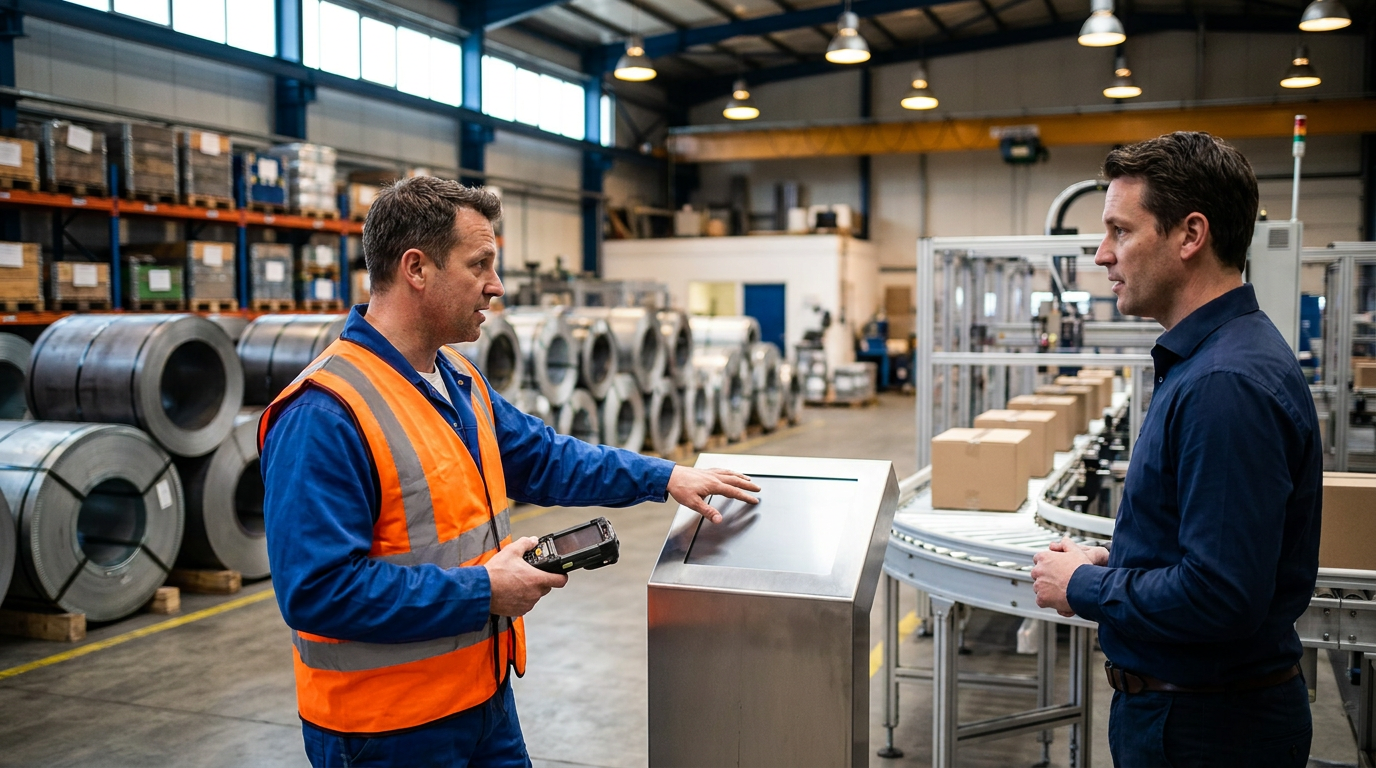
Every week, the technology press publishes dozens of stories about billion-dollar software companies, new computer chips, and artificial intelligence models. Almost none of it is written for the people who actually make, pack, print, and ship physical goods across America.
If you run a manufacturing plant, a distribution warehouse, or a commercial printing and packaging floor, you don't care about Silicon Valley buzzwords. You care about three things:
- How do I get product off my receiving dock, through the machines, and onto outbound trucks faster without hiring three more office clerks?
- How do I take the 30 years of tribal knowledge living inside my plant manager's head and put it on a screen so a new hire can't mess up a custom order?
- How do I get the barcode labels, lot traceability, and automated shipping paperwork required to sell 20 truckloads a month to Walmart, Target, Costco, Home Depot, or national food and medical brands?
Today's technology stories all point to one massive shift: What used to take an army of expensive software consultants six months and $150,000 to build for your plant can now be built and running on your floor in one to two weeks.
Instead of giving you a dry book report, let's sit down at the breakroom table and walk through how this actually sounds for four different people on the shop floor.
1. The Warehouse & Shipping Lead
Who this is for: The person running the loading docks who is tired of clipboards, lost pallets, and handwriting shipping tallies—and wants the company to win huge accounts with national retail and grocery chains.
Warehouse Lead: "Kyle, the owner wants us to start pitching big regional grocery chains and national big-box stores. Those buyers want 10 to 20 truckloads a month. We can make the product all day long, and our warehouse team works hard. Why are we getting locked out of those accounts?"
Kyle Castor: "Because national chains don't just buy your product—they buy your shipping compliance. When your pallet hits a Walmart, Costco, or national distributor dock, they require a specific barcode label on the outside of the wrap, exact lot and expiration tracking inside the box, and an electronic packing list (called an ASN or EDI notice) that hits their computer the second your truck pulls out of your yard. If a pallet shows up with a handwritten tag or a mismatched lot number, their dock rejects the load or hits you with a $5,000 chargeback."
Warehouse Lead: "Right now, when a truck backs up to our receiving dock, my guys write the vendor's boxes down on a paper clipboard, walk that paper into the office at 4:00 PM, and somebody types it into the computer two days later. To get the kind of barcode system those big chains require, the big software vendors told us we need a $100,000 Warehouse Management System and nine months of setup."
Kyle Castor: "That's the old way, and that's what this week's technology news is blowing wide open. Modern computer tools let us build a simple, four-step screen right on an iPad in the dock bay in about two weeks (Unloading -> Spec Check -> Ready to Label -> Completed).
When your forklift driver drops a pallet on the dock, they scan the vendor's box—even if the vendor's barcode doesn't match your part numbers. The tablet immediately translates it, checks the count, and spits out a clean thermal barcode label on a Bluetooth printer clipped to the post. When you load the outbound truck for that national chain, your loader scans each pallet tag onto the truck, and the computer automatically sends the exact electronic shipping notice the chain requires. No clipboards, no 4:00 PM typing backlog, and you are instantly qualified to sell to the biggest chains in the country."
2. The Manufacturing Plant Manager
Who this is for: The operations leader who has a 62-year-old shop foreman who knows every machine, every customer quirk, and every quality rule by heart—and is terrified of what happens when that foreman goes on vacation or retires.
Plant Manager: "My biggest headache isn't the machines—it's the paper travelers taped to the totes. Every job has a paper packet that travels from cutting to assembly to packing. My veteran foreman knows that Customer A needs double-wall cartons, Customer B needs a specific torque check, and Machine 3 needs a 20-step washdown before running a new batch. But when a new operator runs the second shift, they miss a step on the paper sheet, skip a check, and we end up eating $8,000 in scrap."
Kyle Castor: "You have 'tribal knowledge' trapped in one person's head and on a piece of paper that can't talk back. A piece of paper never stops a worker from scanning the wrong raw material box or skipping step 14 of a quality check."
Plant Manager: "Sure, but how do I get 30 years of my foreman's rules into a computer without spending a year in meetings with IT programmers who have never smelled machine oil?"
Kyle Castor: "Two of the biggest stories in tech this week explain how fast this just changed. First, modern AI coding tools can sit down with a recording of your foreman walking the floor for 45 minutes, listen to every rule he says—including his 'Never Rules' (like 'Never start Machine 3 without checking the seal pressure and signing off the 20-step sanitation sheet')—and turn those exact spoken rules into a working touchscreen checklist in days.
Instead of a cluttered computer screen with 50 tiny boxes, the operator at the machine sees a clean tablet with big buttons built for gloved hands (Scanning -> Manager Review -> Quantities -> Manager Completion).
- If they try to start the run before completing the pre-run checklist, the screen stays locked.
- If they scan the wrong raw material lot for that customer's spec, the tablet buzzes red and stops them before they ruin the batch.
- If a count is off by more than 2%, the screen asks for the supervisor's 4-digit PIN right on the glass.
- And if they need to see the customer's engineering drawing or packing diagram, they tap one button (
View Spec Sheet) and the exact PDF pops up on the screen. Your foreman's brain is now permanently built into the shop floor."
3. The Commercial Print & Packaging Production Manager
Who this is for: Leaders running label presses, flexo/offset printing, corrugated converting, or custom packaging plants where roll stock, ink lots, die plates, and customer proofs make or break profitability.
Print & Packaging Manager: "In printing and packaging, our margins live or die on two things: roll waste and lot traceability. A press operator grabs a fresh 2,000-pound master roll of film or paper stock because it's sitting in the front of the aisle, instead of using the half-roll left over from Tuesday. Then, when he finishes the job, he puts the leftover partial roll back on the rack with a piece of masking tape on it. Three weeks later, nobody knows how many linear feet are left on it, or which mill lot it came from."
Kyle Castor: "And let me guess what happens when you pitch a national food, beverage, supplement, or medical device brand?"
Print & Packaging Manager: "They walk our floor for a quality audit and ask: 'If we have a recall on Lot #4829 of our pouches or cartons, how fast can you tell us which master roll of paper, which ink batch, and which shipments had that lot?' If we have to dig through file cabinets of paper press sheets for four hours, we lose the contract on the spot."
Kyle Castor: "Here is how fast a computer fixes that today. When a master roll hits your receiving dock, it gets a durable barcode tag tied to the mill lot and exact footage. When the press operator brings a job up on the press-side tablet:
- FIFO Roll Picking: The screen tells the forklift driver the exact rack and roll tag to grab—forcing them to burn the oldest partial roll first before breaking open a new master roll.
- One-Scan Roll Swaps on Press: If a roll runs out mid-job at 2:00 AM, the operator doesn't fill out paper. They scan the new roll tag onto the active work order in two seconds.
- Remnant Re-Tagging: When the run finishes with 4,200 feet left on the core, the operator taps
Print Remnant Tag, sticks the new barcode on the roll, and the computer knows down to the foot what's sitting on the rack. - 3-Second Recall Audit: When that national food or medical buyer asks you to trace a lot during their audit, you type the lot number into one search box and show them the vendor mill receipt, the press run, the operator sign-off, and every customer shipment in three seconds flat. That is how a regional printer wins national consumer-brand contracts."
4. The Owner of a Growing Multi-Plant Manufacturer
Who this is for: The business owner or president who just bought a second facility (or is running two warehouses on two old systems) and wants to cross-sell to all customers immediately.
Business Owner: "We just bought a great manufacturing shop two states over. The problem is they have 15 years of customer invoices, part numbers, and inventory sitting in an old computer system, and we run our main plant on ours. The software consultants told me it's going to take 8 months and $300,000 to clean up the part numbers and merge the two systems. I don't have 8 months—I want my sales team selling both catalogs to national buyers on Monday morning!"
Kyle Castor: "Eight months is for people who are still matching part numbers line-by-line in spreadsheets by hand. One of the biggest breakthroughs in this week's reports is how fast modern AI processes massive piles of messy business records.
When Plant A calls a part BRK-100-SS and Plant B calls the exact same stainless bracket STEEL-MOUNT-A, a computer can read all 15 years of both plants' item catalogs, customer lists, and vendor bills, spot every duplicate, build a clean crosswalk table, and lock the entire historical record into a tamper-proof digital vault in 48 hours.
By Monday morning, your sales reps see both warehouses' live inventory on one screen, your accounting team closes one set of books without spending 15 days in Excel, and your customers get one clean invoice whether their order shipped from Ohio or Texas."
The 5-Minute "Walk-the-Floor" Check
Tomorrow morning, grab a cup of coffee, walk out onto your shop floor or shipping dock, and look for these three things:
- The Clipboard Test: Count how many places a worker writes a number on a piece of paper (dock receipts, press tally sheets, quality checklists, pallet counts) only for someone else to type that same number into a computer hours or days later. Every clipboard is a speed limit on how much you can ship.
- The Stopwatch Test: Pick one finished pallet sitting by your bay door right now. Ask your supervisor: "Show me which raw material delivery went into this pallet, who signed off on the machine setup, and which other customers got material from that same batch." If it takes more than 10 seconds, you have a traceability gap that is costing you bigger accounts.
- The National-Chain Test: Ask yourself: "If a national chain called us today and ordered 20 truckloads a month, could our shipping dock handle the barcode labels, pallet tallies, and electronic shipping notices without hiring a single new office clerk?"
You don't need a six-month corporate IT project, and you don't need to pay $100,000 a year in software license fees for every worker who touches a scanner. A modern, plain-English shop-floor screen can be built around your exact machines, your quality rules, and your customers in a one-to-two-week sprint—so your team can spend less time chasing paper and more time shipping product.
Sources Summarized in This Week's Read (TLDR Tech — October 15, 2026)
- Google Gemini 2.5 Flash-Lite & High-Speed Enterprise Inference — Why computer lookups, document reading, and barcode translation on shop-floor tablets now happen in milliseconds for fractions of a penny.
- Anthropic Claude Code & Agentic Software Engineering Workflows — How software engineers now build custom shop-floor screens, barcode labelers, and ERP workflows in days instead of six-month consulting projects.
- OpenAI Enterprise Context & Memory Architectures — How businesses capture 30 years of a veteran plant manager's spoken rules and SOPs into governed, step-by-step computer checklists.
- Shopify & Retail Supply-Chain Automation Standards — Why national retailers and omnichannel buyers are tightening automated ASN, EDI, and pallet-level barcode compliance for all suppliers.
- Cloudflare Zero-Trust & Edge Worker Security — How shop-floor iPads use simple, secure 4-digit operator and manager PIN gates without buying $1,500/year ERP user licenses for every warehouse worker.
- Stripe & Real-Time B2B Settlement Infrastructure — How instant proof-of-delivery and clean barcode fulfillment cut days off invoicing and get manufacturers paid faster.
- Apple iPadOS Industrial & Bluetooth Peripheral Reliability — Why off-the-shelf tablets paired with industrial Bluetooth barcode scanners and Zebra thermal printers are replacing clunky $4,000 proprietary RF guns.
- PostgreSQL / SQLite High-Speed Verification & Ledger Indexing — The math behind compressing 15 years of factory invoices and lot numbers into a 2-second recall search.
- Modern Computer Vision & OCR for Damaged Vendor Labels — How dock tablets read smudged, torn, or mismatched supplier labels at the receiving bay door.
- Automated Software Regression & Quality Gates — Applying hard "Never Rules" to manufacturing work orders so bad data or wrong raw materials are blocked before the machine starts.
- Private Equity & Mid-Market Roll-Up Operational Benchmarks — Why multi-plant owners are demanding 48-hour system unifications instead of 9-month IT distractions.
- US Domestic Manufacturing & Reshoring Output Report — Why American mid-market plants that automate their dock-to-press-to-truck paperwork are winning contracts away from overseas suppliers.
Figures in this paper are modeled composites unless a source class says otherwise. Source text: markdown version • Service: Print, Scan and Weigh Consolidation Across a Portfolio
Talk to the architect, not a salesperson
Aissistor technology for NetSuite: the five roles a company pays for, absorbed into one governed box at a modeled 20-80% lower cost, with the existing team repurposed rather than replaced, and every outcome published in a 100x time ledger with its source class. Read the ledger.
Schedule a strategy call Run the five-role calculator
The direct email and phone number are shared in the receipt of a verified request.